
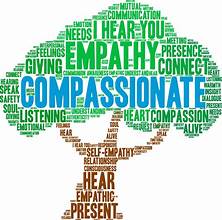
Compassion means not just to feel for, but also to feel with another. The origin of the word combined “com” (together), with “pathos” (pain or suffering.) Hence, it meant to “feel with or share in another’s pain.” And in the Hebrew Bible, “compassion” took its root in “womb love,” the love of a mother for the child who issued from her womb. You do not get a more intense feeling with than that. In short, compassion generates powerful fellow-feeling and solidarity. It is by nature inclusive rather than divisive, a “we” rather than “he or she.”
Compassion is therefore risky, rendering you vulnerable. It may prompt you not merely to observe, but to actually do something to alleviate another’s suffering. It may motivate you to personally enter into the daily life and even consciousness of another, and from that intimate stance to see and sense how things are with them not just from the outside, but also from the inside. This has been called a process of “going over and coming back.” You attempt to go over and stand in their shoes, in spirit at least, in order to feel what they are feeling. Then you come back, also in spirit, into your own shoes and life context. Through this time-honored process, you can grow and mature in your understanding of the trials and tribulations of humanity at large.
Compassion expands acceptability. You cannot have compassion for and negativity toward another at the same time. With compassion, you do not want to know how things are only from your perspective, but also from the perspective of the one under duress, who is suffering what you are fortunate not to be suffering—at present at least. Should you have gone through something like that yourself before, it would definitely increase your understanding of what the other may be going through, and will likely need by way of assistance.
It can be more difficult to have compassion for loved ones than for strangers, due in large part to your having more at stake in the love relationship. The higher your hopes and expectations for how you want to be treated by a loved one, the greater the possible frustration, when they fail to meet them. In a similar way, it may be more difficult to have compassion for yourself than for others. We can be our own worst enemy as well as our best friend.
Not to feel compassion for others is a serious, make that even grave, shortcoming of too many of us. Not wanting to feel pain, we back up and seek to avoid the floods of fellow feeling completely. This eventuates in personal and communal loss, something we are experiencing now, in these divisive days. We are witnessing not only the best but also the worst that is in us. Some rise up and amaze us with their compassion, which leads them to make a difference in the suffering of their neighbors and communities. Others show little or no compassion, especially for the “little people”, the seemingly insignificant persons in need of assistance due to circumstances beyond their control. Many of us are in unexpressed need of assistance, also due to circumstances beyond our control, but perhaps out of pride, we choose to keep it to ourselves.
When you witness little persons having compassion for other little persons, it does your heart good. It strengthens your belief in the fundamental goodness abiding in most every person.
Leave a Reply